Commercial Waste Beckenham: Recycling and Sustainability
 Welcome to our overview of Commercial Waste Beckenham and the steps being taken to create a truly eco-friendly waste disposal area and a resilient sustainable rubbish area. This page outlines our ambition, practical measures, and collaborative work across the borough to reduce landfill, cut carbon emissions and improve recycling rates for businesses, property managers and service providers handling Beckenham commercial waste.
Recycling percentage target and measurable goals
Our target is clear: achieve a 65% recycling rate for commercial waste in Beckenham by 2028, with interim milestones of 50% by 2025. This recycling percentage target focuses on material capture, reuse and avoiding waste to landfill. Targets are tracked monthly and reported in aggregated form so organisations can benchmark their performance against the borough-wide aims.What we include in the target
 The target counts separate streams that are standard in local approaches to waste separation: paper and card, glass, metals, plastics (rigid and film where separate collection exists), food waste, green garden waste and bulky items diverted to reuse. We also measure the diversion of electronic waste and construction-derived materials when businesses follow Beckenham commercial recycling protocols. Key operational levers include better segregation at source, on-site compaction for recyclables and working with local processors to maintain high-quality streams.
Partnerships are central. We work with a network of transfer stations and material recovery facilities across south and southeast London so that collected tonnes enter established recycling pathways quickly and efficiently. Local transfer stations accept segregated loads from Beckenham collections and ensure materials are sorted, baled and delivered to the right processors — supporting the circular flow of resources and strengthening the eco-friendly waste disposal area across the borough.
Beyond infrastructure, we have active partnerships with charities and social enterprises to maximise reuse. Unsold retail goods, surplus office furniture, white goods in working order and refurbished electronics are remanufactured or redistributed rather than shredded or crushed. Partner charities collect reusable items directly or through coordinated bulk uplift programmes, turning potential waste into value for local communities and reducing pressure on municipal treatment systems.
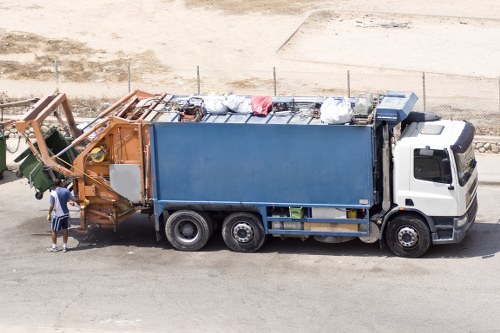 Our Beckenham commercial waste teams also support targeted schemes for bulky waste reuse. Items in usable condition are triaged at collection or drop-off and offered to charity partners. When reuse is not viable, materials are dismantled and routed to suitable recycling streams — metals to smelters, timber to chipboard processors, and WEEE to certified recyclers — maintaining compliance with environmental regulations and maximising resource recovery.
Low-carbon vans and greener logistics are a cornerstone of reducing the carbon footprint of commercial waste in Beckenham. The fleet has been progressively upgraded to include electric and hybrid vans on dense inner-borough rounds, while low-emission diesel alternatives are used selectively for longer, less-accessible routes. Intelligent route optimisation reduces empty miles and consolidates collections to lower overall emissions across the sustainable rubbish area.
Key fleet features:
- Deployment of battery-electric vans on shorter urban circuits to cut NOx and CO2 emissions.
- Hybrid vehicles on mixed-distance rounds to balance range and efficiency.
- Use of biofuel blends and driver eco-training where electrification is not yet feasible.
These steps, together with load optimisation and scheduled maintenance, help ensure that Beckenham commercial waste collections are consistent with a low-carbon transport strategy. Metrics such as kgCO2e per tonne collected are tracked to quantify improvements over time.
The borough's approach to waste separation plays a big role in success. The local authority promotes separate containers for dry recyclables, food and garden waste in both public and private commercial settings. Clear signage, trusted collection cadences and simple separation rules reduce contamination rates. Businesses are encouraged to adopt standard bin colour-coding and to run internal training so that staff and contractors know exactly what belongs in each stream.
 Practical measures in the sustainable rubbish area include on-site compactors for high-volume cardboard, dedicated skips for inert construction waste, and secure storage for confidential paper recycling. We also encourage anaerobic digestion partnerships for food waste from restaurants and catering services, turning organic waste into energy and digestate — a prime example of circular practice embedded in Beckenham commercial recycling.
 Measurement and continuous improvement underpin everything. Regular waste audits identify opportunities to increase capture rates, lower contamination and shift tonnes from disposal to reuse. Businesses are supported with bespoke action plans that recommend collection frequency, container types and reuse pathways. Together, these initiatives create a robust eco-friendly waste disposal area and a long-term vision for a resilient, sustainable rubbish area serving the needs of Beckenham’s commercial community.
